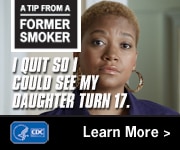
The Center for Disease Control and Prevention’s (CDC) Office on Smoking and Health (OSH) launched a second national media campaign on
March 4, 2013, to raise public awareness about health consequences of smoking and second-hand smoke and to encourage quit attempts as well as promote cessation services, such as quitlines. The campaign is called Tips From Former Smokers(Tips 2) and it features real people who have experienced a variety of illnesses stemming from tobacco use. CDC is building on the success of the first Tips campaign by launching a
new round of advertisements in April 2013 to raise awareness of the negative
health effects caused by smoking, encourage smokers to quit, and encourage
nonsmokers to protect themselves and their families from exposure to secondhand
smoke. The new campaign ads will feature additional health conditions (chronic obstructive
pulmonary disease [COPD], asthma in adults, smoking-related complications in a person
with diabetes), and population groups (American
Indian/Alaska Native; Lesbian, Gay,
Bisexual, and Transgender) that were not included in the first Tips
campaign.
The primary goals of the campaign are to:
- Encourage smokers to quit and make available help for those who want it, including calling 1-800-QUITNOW or visiting www.smokefree.gov for free help
- Build public awareness of the immediate health damage caused by smoking and exposure to secondhand smoke
- Encourage smokers not to smoke around others and nonsmokers to protect themselves and their families from exposure to secondhand smoke
The key messages of the
campaign are:
- Smoking causes immediate damage to your body,
which can lead to long-term health problems.
- For every person who dies from a smoking-related illness, 20 more Americans live with an illness caused by smoking.
- Now is the time to quit smoking, and if you need help, free assistance is available.
The campaign ads, which began airing on March 4th, will run for 16 weeks and include paid advertising and public service announcements
(PSAs) on television; radio; print; out-of-home (e.g., billboards); and digital
outlets. Additional information and resources will be made available to the
public through social media channels, including Facebook, Twitter, YouTube, and
Pinterest. For information on how to access these social media platforms, visit
the Tips Stay Connected page. Two new aspects of this
year’s campaign include:
- A Spanish-language portal will be launched to connect callers with Spanish-language quitline services in their states. The portal can be accessed through 1-855-DEJELO-YA (1-855-335-3569).
- A special promotion Talk to Your Doctor will be conducted midway through the campaign. This promotion encourages smokers to talk with their health care providers for help in quitting.
As part of the this year’s Tips campaign, CDC has partnered with five medical societies (AMA, AAFP, AAP, ACP and ACOG) to support a new initiative called "Talk With Your Doctor,” which encourages smokers to talk with their health care providers about quitting. From May 27th through June 2nd, select Tips From Former Smokers television ads as well as digital and online ads will feature the following tagline:"You Can Quit. Talk With Your Doctor for Help.”
Please click on the questions below to access an appropriate section of the page. If you are not finding what you are looking for, please contact NAQC at naqc@naquitline.orgor 800-398-5489 ext. 701.
Where can I view the campaign ads?
How can I receive additional updates on the CDC's national media campaign?
Who is the media contact at NAQC?
What are quitlines and what services do they offer?
How can I get help quitting smoking cigarettes or other types of tobacco?
Quitline Specific Questions
We have received several calls from residents of another state. How do we transfer these calls to the correct state?
How can I access NAQC updates on the Campaign?
How can I tap into the expertise of my quitline peers?
Where can I view the campaign ads?
Please visit the campaign website - www.cdc.gov/quitting/tips- to find detailed information on the ads and former smokers featured in them.
Campaign
resources available on this the Tips website for smokers and nonsmokers
include:
o Quit Guide
A guide to help you quit cigarette smoking, including reasons to quit, steps to
quit, tips on handling cravings, medications that can help, and what to do if
you slip
o Topics Related
to Quitting
Topics related to quitting smoking, including the benefits of quitting,
depression basics, stress and smoking, and withdrawal
o Quitting
Resources
Other Web sites and resources to help you quit smoking
Other
campaign materials are available free, for a limited time, at CDC’s Tips From Former Smokers Download Center. These
materials can be used free of charge for educational or information purposes or
as part of community or organization programs to decrease smoking and encourage
quitting. They include:
- Low-resolution TV, print, radio, online, and out-of-home ads for
use by educators, health care providers, and community organizations
- Continuous-loop videos for doctors’ offices, clinics, etc.
- Public service announcements about quitting smoking and the
effects of secondhand smoke (available in English and Spanish)
For
information about broadcast-quality ads, use of PSAs for media, use of
materials in textbooks, and use of materials as part of a media buy or
placement, please contact CDC’s Media
Campaign Resource Center.
»
back to top
How can I receive additional updates on the CDC's national media campaign?
- Campaign
Resources – View and use a variety of resources offered.
- Press Room – Access and
download press materials, including the campaign press release, matte articles,
disease/condition overviews, and print-ready photos of the ad participants.
- Buttons –
Show
your support for the campaign on your own Web site—send a strong message to
your site’s visitors to quit smoking or never start—with downloadable
buttons that share the Tips image and connect visitors with campaign
information and resources.
- Stay Connected–Stay connected and feature Tips materials across social media channels. Share our Facebook posts. Retweet from @CDCTobaccoFree. Share YouTube videos and link to the Tips from Former Smokers playlist. Repin from the Tips Pinterest board.
Or
use this sample Facebook post and Tweet on your own social media channels:
- Facebook: CDC continues to educate people on the real
consequences of smoking and exposure to secondhand smoke with the launch of the
2013 Tips From Former Smokers campaign. Learn more about the participants and
their stories: www.cdc.gov/tips
- Twitter: CDC continues to educate on real consequences
of smoking & exposure to secondhand smoke with 2013 #CDCTips campaign. www.cdc.gov/tips
- Matte Articles – Download matte articles
about the Tips campaign—written for the general population and specific
groups that can be tailored and used in newsletters, local newspapers, or
medical society bulletins.
- Videos – Watch the Tips TV
ads and vignettes to hear participants tell their compelling personal
stories.
- Real Stories – Read short biographies
of the real people featured in the Tips campaign who are living with
serious long-term health effects from smoking and from breathing secondhand
smoke.
- Disease/Condition Overviews –
Learn
the facts about the smoking-related diseases and
conditions featured in the campaign, including COPD, cancer, asthma,
diabetes, Buerger’s disease, heart disease, and stroke.
- Spanish Materials–A new campaign participant, Mariano, is now featured for Spanish-speaking audiences.Many campaign materials and resources are being translated into Spanish. Check out www.cdc.gov/consejos for new content.
»back to top
Who is the media contact at NAQC?
For media related inquiries, please contact Natalia Gromov, Administrator, at media@naquitline.org or 800-398-5489 ext. 701.
»back to top
What are quitlines and what services do they offer?
Quitlines are telephone-based tobacco cessation services that help tobacco users quit. Services offered by quitlines include coaching and counseling, referrals, mailed materials, training to healthcare providers, Web-based services and, in some instances, free medications such as nicotine replacement therapy (NRT). You can learn more about the services available in your state at this link.
Much research shows that quitlines are highly effective in helping tobacco users quit. Due to their ability to reach and serve tobacco users, regardless of location, quitlines have quickly spread across North American. Today, residents in all 50 states, the District of Columbia, each U.S. territory, all ten Canadian provinces and two territories have access to public quitline services.
What is a Quitline?This fact sheet provides an overview of the quitline experience.
Who Uses Quitlines?This fact sheet describes the many types of tobacco users who call quitlines for help in quitting.
How can I get help quitting smoking cigarettes or other types of tobacco?
Are you ready to quit? Receive free quitting support, including quit coaching, educational materials, and referrals to local resources today!
For service in Asian languages
Website: http://www.asiansmokersquitline.org/
Note: Please note that North American Quitline Consortium does not provide quitting services.
Get more information about free quitline services available in your area by visiting the quitline map. Profile pages include details about services offered, hours of operation, patient referrals, and more for quitlines in each state, territory, and Canadian province. You may be eligible for free online help to quit smoking, depending on your state. The quitline map can provide you with that information as well, or see other web-based quitting resources below.
Note: This map requires Adobe Flash Player 10.0. If you do not have the player installed, please click hereto download and install it.
SmokeFree.gov
Smokefree.gov is intended to help you or someone you care about quit smoking. The information and professional assistance available on this site can help to support both your immediate and long-term needs as you become, and remain, a nonsmoker.
EX
The EX Plan is a free quit smoking program that allows you to customize a quitting program, track success, and communicate with your peers in an online environment.To access the website, go to www.becomeanex.org.
»back to top
We have received several calls from residents of another state. How do we transfer these calls to the correct state?
From time to time, a call from a resident of another state may be received by your quitline. A protocol has been designed so that quitlines can route such callers to their correct state quitlines. It is called "take back and transfer” and is described at the here.
»back to top
How can I access NAQC updates on the Campaign?
NAQC will be sending out regular updates throughout the campaign. Links to the e-communications are included below:
coming soon!
»back to top
How can I tap into the expertise of my quitline peers?
NAQC encourages all members to use our peer-to-peer networking listserv to collaborate on challenges and ask questions in real-time. To learn more about the listserv, please click here.
»back to top
