Leading Health Groups Urge AGs to Investigate R.J. Reynolds' New Magazine Ads for Camel
Thursday, May 30, 2013
Posted by: Natalia Gromov
FOR
IMMEDIATE RELEASE: May 30, 2013
CONTACTS:
Peter
Hamm, Campaign for Tobacco-Free Kids, 202-296-5469
Julia
Cartwright, Legacy, 202-454-5596
Lauren
Walens, American Cancer Society Cancer Action Network, 202-661-5763
Retha
Sherrod, American Heart Association, 202-785-7929
Mary
Havell McGinty, American Lung Association, 202-715-3459
Leading
Health Groups Urge State AGs to Investigate
R.J.
Reynolds’ New Magazine Ads for Camel Cigarettes
WASHINGTON,
DC –
Five leading public health organizations are calling on state attorneys general
to investigate whether R.J. Reynolds’ new magazine
advertising campaign for Camel cigarettes violates the state tobacco
settlement’s prohibition on targeting youth.
The
ads, for Camel Crush cigarettes, have appeared in the April, May or June issues
of at least 24 magazines, including several with large teen readerships.
This is the first time R.J. Reynolds has advertised a cigarette brand in
magazines since December 2007, when the company suspended its magazine
advertising while facing public and Congressional scrutiny and lawsuits by nine
states for engaging in marketing that targeted kids.
The
health groups are urging the state attorneys general to investigate whether the
ad campaign violates a provision of the 1998 settlement that prohibits tobacco
companies from taking "any action, directly or indirectly, to target Youth
within any Settling State in the advertising, promotion or marketing of Tobacco
Products.”
"We
believe that R.J. Reynolds’ new ad campaign does directly or indirectly target
youth because the entire ad buy is reaching millions of youth and several of
the individual magazines have large youth readerships,” the health groups
stated in a letter
to the Tobacco Committee Co-Chairs of the National Association of Attorneys
General.
The
groups involved are the Campaign for
Tobacco-Free Kids, Legacy, American Cancer Society Cancer Action Network,
American Heart Association and American Lung Association.
Publicly
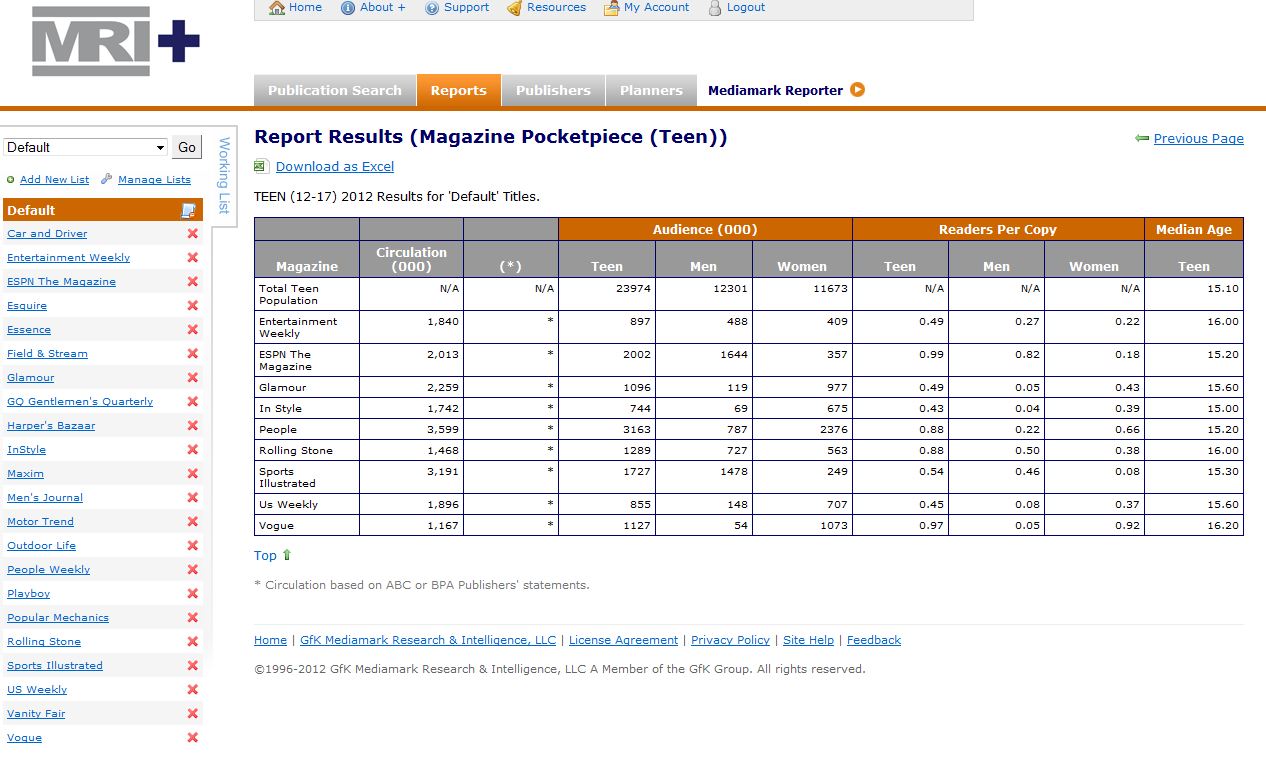
available data from GfK MRI, a consumer research firm, shows a total teen
readership (12-17 years old) of 12.9 million for just nine of the magazines
involved – Entertainment Weekly, ESPN the Magazine, Sports Illustrated,
Rolling Stone, People, Glamour, InStyle, US Weekly and Vogue.
The total teen readership for all 24 magazines would be millions more.
Several
of these magazines individually have large teen readerships, including People
with nearly 3.2 million teen readers, ESPN the Magazine with more than 2
million teen readers, and Sports Illustrated with more than 1.7 million
teen readers.
The
health groups’ letter points out that R.J. Reynolds’ has a long history of
being investigated and legally sanctioned for targeting kids with marketing for
Camel cigarettes:
·
From
1987 to 1997, R.J. Reynolds marketed Camel cigarettes with a cartoon character,
Joe Camel, including through magazine ads. Studies showed that Camel’s
share of the youth cigarette market soared after the campaign began, and Joe
Camel at one point was nearly as recognizable to 6-year-olds as Mickey
Mouse. R.J. Reynolds finally ended the Joe Camel campaign in 1997 in the
face of lawsuits, Congressional scrutiny, a Federal Trade Commission
investigation and public outrage.
·
In
2001, the State of California sued R.J. Reynolds, alleging that the company’s
placement of cigarette ads in magazines with large numbers of teen readers
violated the settlement’s prohibition on targeting youth. In 2002, a
California judge found R.J. Reynolds liable, a ruling upheld by a California
Court of Appeal. Under a 2004 settlement of the case, R.J. Reynolds agreed
to restrictions on its advertising in magazines with large teen readerships and
paid $17.25 million in civil penalties and costs.
·
In
2007, R.J. Reynolds faced criticism from public health and women’s
organizations, members of Congress and newspaper editorials after it introduced
Camel No. 9 cigarettes targeted to teenage girls and young women. U.S.
Rep. Lois Capps (D-CA) called Camel No. 9 "the pink version of Joe Camel.”
·
In
November 2007, R.J. Reynolds again faced criticism for a large Camel ad in Rolling
Stone that was wrapped around a cartoon insert. Nine states sued the
company, alleging that it violated the MSA’s prohibition on the use of cartoons
in tobacco advertising.
Amidst
controversy over the Camel No. 9 and Rolling Stone ads, R.J. Reynolds in
late 2007 announced that it would suspend its cigarette advertising in
magazines.
Camel
is one of the three most popular cigarette brands among youth smokers, with
15.1 percent preferring Camel, according to the 2011 National Survey on Drug
Use and Health. Camel Crush is an extension of the brand with a capsule
in the filter that releases menthol when crushed.
"R.J.
Reynolds cannot be allowed to get away with yet another marketing campaign that
entices America’s kids into a deadly addiction,” the health groups’ letter
states.
Related
Information
Public
health groups’ letter to the attorneys general
Advertising
for Camel cigarettes, including the new Camel Crush ads
List
of magazines in which the ads have run
GfK
MRI data on teen readership for nine of the magazines
Source: Campaign for Tobacco-Free Kids
|

 Email to a Friend